Which street food
market?
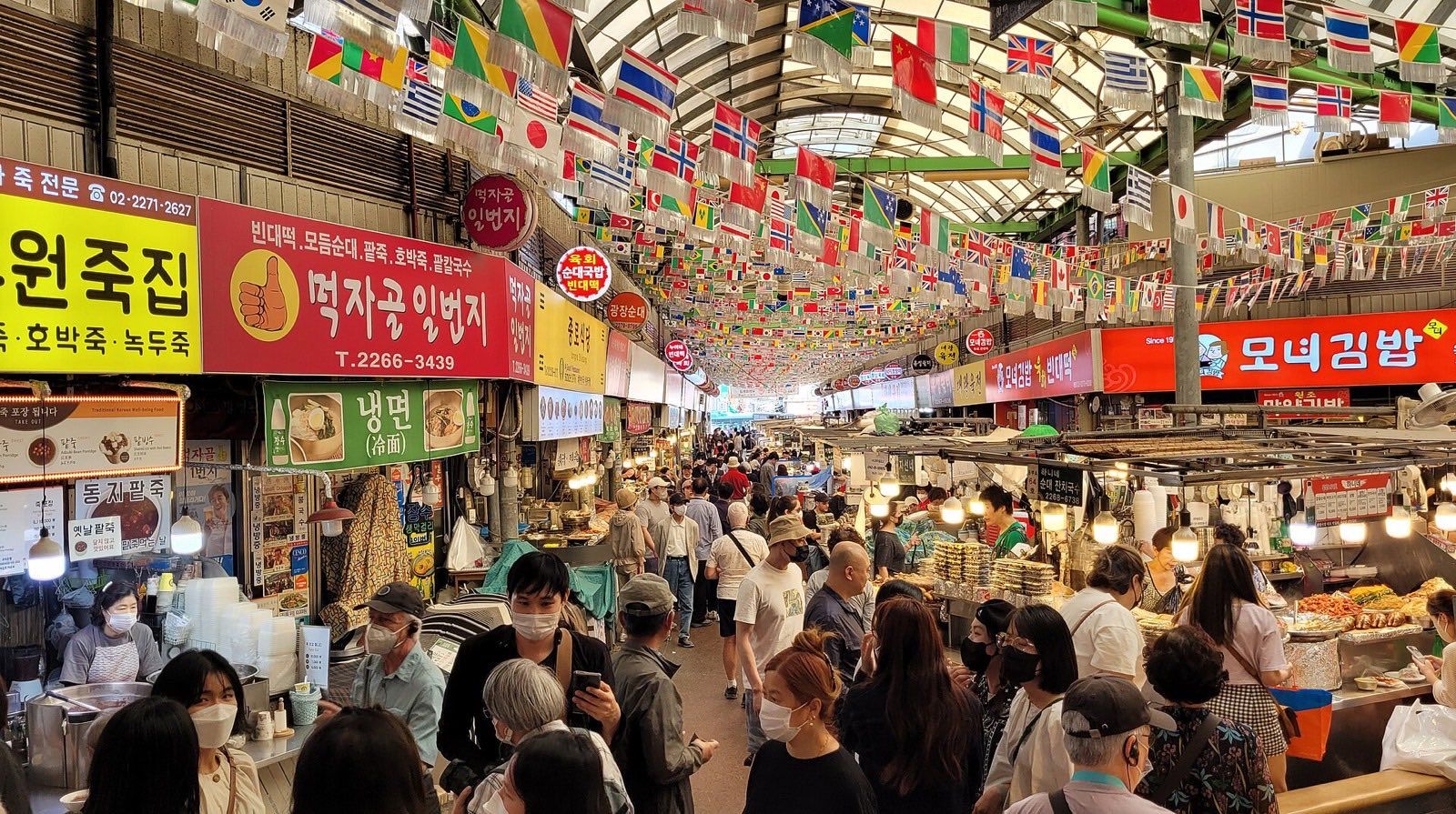
If you do one market, it's Gwangjang: the food alley runs 09:00–23:00, the bindaetteok is ₩5,000, and a full graze-dinner with makgeolli comes to about ₩20,000. Take Line 1 to Jongno 5-ga, Exit 8 and you're standing in it. Myeongdong's night market is a fun second (tourist prices, big energy), Mangwon is the best-value local option, and Tongin's coin-lunchbox gimmick is skippable unless you're already next door. Go hungry, go in the evening, carry some cash.
Seoul street food markets compared
| Market | Get there | Hours | Signature | Verdict |
|---|---|---|---|---|
| Gwangjang | Line 1, Jongno 5-ga, Exit 8 | 09:00–23:00 (food alley) | Bindaetteok ₩5,000 · yukhoe · mayak gimbap | WORTH IT |
| Myeongdong street market | Line 4, Myeongdong, Exit 6 | 17:00–23:00 | 150+ carts — grilled lobster, hotteok, egg bread; tourist prices but fun | WORTH IT |
| Tongin | Line 3, Gyeongbokgung, Exit 2, then 10-min walk | 11:00–16:00 for the lunchbox | Dosirak: trade brass coins for a build-your-own lunch tray | DEPENDS |
| Mangwon | Line 6, Mangwon, Exit 2 | ~10:00–21:00 | Locals' produce market + snack stalls at half tourist prices | DEPENDS |
Verdicts assume a 3–5 day trip. Mangwon's DEPENDS is about your time, not its quality — it's the best value of the four, it's just not near anything else you're doing.
Gwangjang: do this one
A century-old covered market where the central food alley is the point. Your order, in sequence: bindaetteok (₩5,000) from a stall grinding mung beans in the window — eat it at the counter with a ₩4,000 bottle of makgeolli. Then mayak gimbap (₩3,000–4,000), the little 'narcotic' seaweed rolls with the mustard dip. Still going: kalguksu (₩9,000) from the noodle aunties, or yukhoe (₩15,000) — raw seasoned beef with pear — from the dedicated yukhoe alley on the market's east edge, which is better than it sounds and has the queues to prove it.
Go between 18:00 and 21:00 when the alley is at full roar. It's shoulder-to-shoulder on weekends — that's the correct experience, not a reason to avoid it. Most stalls now take card, but bring ₩20,000–30,000 in cash anyway: the alley moves faster on cash and a few grannies still wave cards off. If you'd rather have it narrated the first time, the food tours route through here or a market like it.
Myeongdong: the carnival version
Not a market building — a shopping district whose main drags fill with 150+ carts from about 17:00. Order the hotteok (₩2,000), the gyeranppang egg bread (₩3,000), a tornado potato (₩4,000), and split a grilled cheese lobster tail (₩15,000) because you're on holiday. Budget ₩15,000–20,000 for a full graze. Yes, it's the most expensive street food in Seoul and yes, it's aimed squarely at tourists — it's also genuinely fun, and if you're staying in Myeongdong it's literally outside your hotel. Full neighborhood rundown on our Myeongdong page.
Tongin: the coin lunchbox
Tongin's thing is the dosirak cafe: pay ₩5,000 for a tray and ten brass yeopjeon coins, then walk the alley trading coins for small portions — a scoop of tteokbokki here, a fried croquette there. It's charming for about 25 minutes, the food is fine rather than great, and the coin system only runs roughly 11:00–16:00 (closed Mondays). Verdict: DEPENDS — do it if you're already at Gyeongbokgung, a 10-minute walk away, and it's lunchtime. Don't cross the city for it.
Mangwon: the best value
Mangwon is what Gwangjang was before the cameras: a working neighborhood market on Line 6 where the customers are grandmothers with shopping trolleys. Prices run half of Myeongdong's — kalguksu ₩5,000, twisted doughnuts ₩1,000, fried chicken boxes ₩8,000 — and quality stays high because the clientele is ruthless. No English signage, no show; that's the appeal. Pair it with the Han River park five minutes' walk away, or with an evening in Hongdae, one stop over. Best value of the four; DEPENDS only because it's a detour on a short trip.
Do a market with a guide
If pointing at unlabeled food stresses you out, one guided night fixes it permanently. Full comparison on the food tours page.
FAQ
What should I order at Gwangjang Market?
The core three: bindaetteok (₩5,000 mung-bean pancake), mayak gimbap (₩3,000–4,000 mini seaweed rolls), and makgeolli (₩4,000 a bottle). Add kalguksu noodles (₩9,000) if you want a sit-down course, and yukhoe (₩15,000 raw seasoned beef) if you trust us — the yukhoe alley has been doing exactly this for decades.
What are Gwangjang Market's opening hours?
The goods-and-fabric halls run roughly 09:00–18:00, but the food alley keeps going to about 23:00, seven days a week — stalls set their own hours and a few close Sundays. Evening, 18:00–21:00, is when it's at its best.
Do Seoul market stalls take credit cards?
Increasingly yes — most Gwangjang and Myeongdong stalls now take cards or Kakao Pay. Carry ₩20,000–30,000 cash anyway: some older stallholders are cash-only and queues move faster. Every convenience store has an ATM that takes foreign cards.
Is Gwangjang Market too touristy now?
The famous stalls, yes — expect cameras and queues at the ones that have been on Netflix. It doesn't really matter: the food is cooked the same way for the same ₩5,000, and half the crowd is still Korean. For the zero-tourist version, take Line 6 to Mangwon instead.
Which market is best on a rainy day?
Gwangjang — it's fully covered, so the food alley runs at full tilt in a downpour. Myeongdong's open-air carts thin out in real rain. More wet-weather plans on our rainy day page.