Plan the
boring bits.
The 60-second version: land at Incheon and take the AREX train (all-stop ₩4,750, express ₩11,000) or a private transfer if it's late or you're four people. Buy a T-money card at any CU or GS25 — ₩2,500 for the card, load ₩20,000 — and it taps you through every subway, bus and most taxis. Install an eSIM before you fly, and put Naver Map on your phone because Google Maps can't route you here. The subway answers almost every 'how do I get there' question from 05:30 to midnight. That's genuinely 90% of Seoul logistics; the rest is below.
Getting from Incheon
Three real options. The AREX express train — ₩11,000, 43 minutes nonstop, Terminal 1 to Seoul Station, guaranteed seat — is the move when you land during the day and stay near a Line 1/4 transfer (looking at you, Myeongdong). The all-stop AREX costs ₩4,750, takes about 60 minutes, and calls at Hongik University Station on the way — which makes it the better train if you're staying in Hongdae, no transfer needed.
The third option is a private transfer, and it stops being a luxury in exactly three cases: you're a family of 3–4 (the math beats four train fares plus a taxi leg), you land after 23:00 when the trains stop and the taxi queue crawls, or you're jet-lagged with big luggage and simply done problem-solving. Expect $65–85 to central Seoul, driver waiting at arrivals with your name on a sign.
Skip: the airport limousine buses unless one stops literally at your hotel (bus 6015 does serve Myeongdong's main street), and any taxi tout who approaches you inside the terminal — the regulated ranks are outside.
T-money and the subway
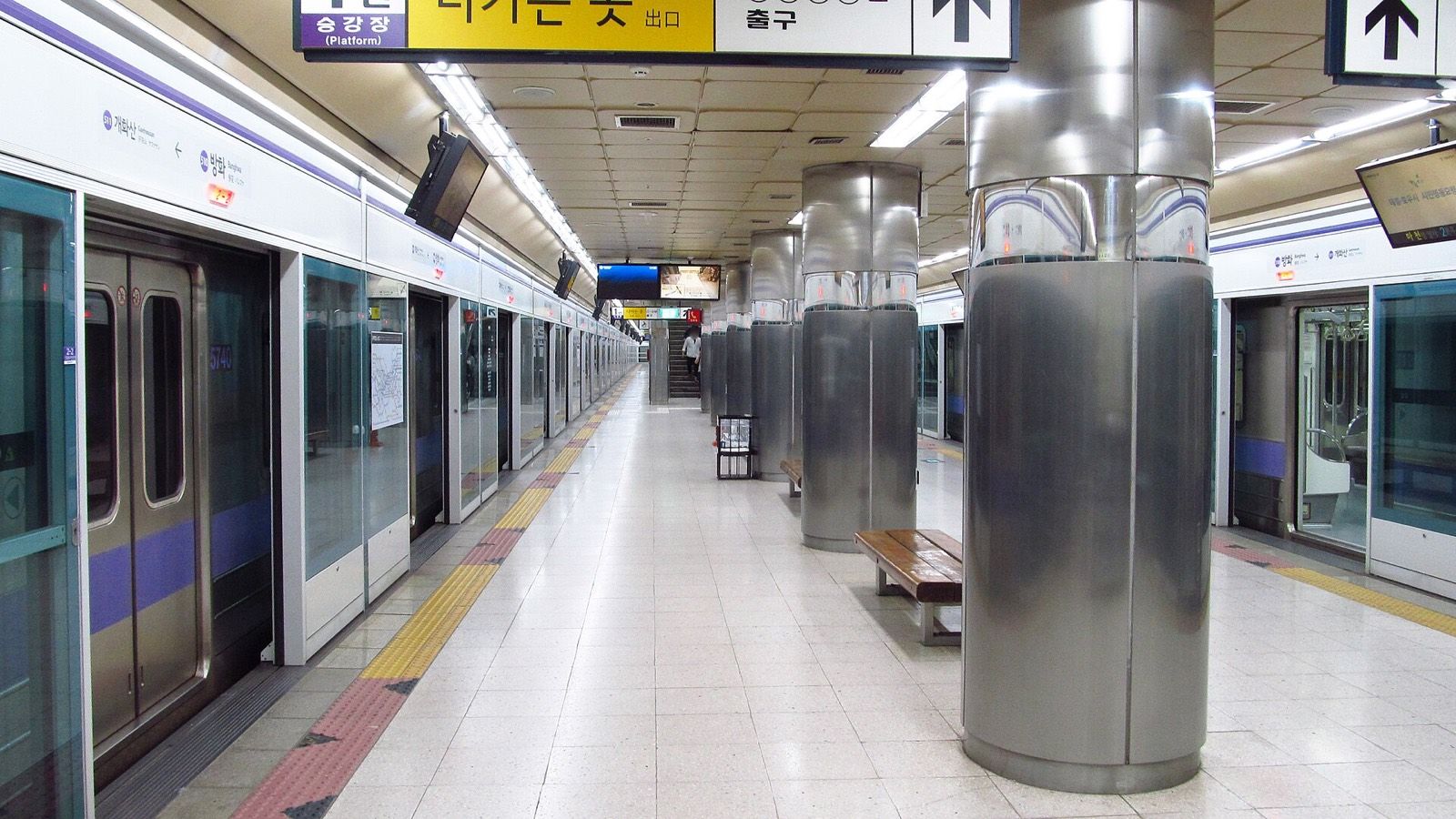
The subway is the answer to nearly every transport question in this city: fares from ₩1,500, trains every 2–5 minutes, English signage everywhere, running roughly 05:30 to midnight. Buy the T-money card at the convenience store in the arrivals hall — ₩2,500 for the card, then load cash (start with ₩20,000; machines in every station reload it). It works on subways, buses, most taxis and at convenience-store tills. One card per person; kids' cards get discounted fares.
Now the thing nobody warns you about: Google Maps barely works in Korea. Map-data export restrictions mean it can't properly route walking or driving directions — it will happily strand you staring at a blue dot. Install Naver Map (best English support) or Kakao Map before you land and use them for everything: subway routing with exit numbers, walking turns, bus arrivals. Every itinerary on this site assumes you can follow a Naver exit number.
Taxis fill the post-midnight gap: base fare ₩4,800, most trips inside the center under ₩15,000, meters universal and honest. Hail through the Kakao T app to skip the language negotiation entirely.
Data: eSIM before you fly
Buy an eSIM before you leave home — it installs in five minutes from your sofa and comes alive the moment you land, which matters because your first hour in Korea (AREX tickets, Naver Map, messaging the hotel) is exactly when you need data most. Unlimited-data Korea eSIMs run $15–25 for a week, and Korea's LTE/5G coverage is about the best on earth, including the entire subway network.
The airport SIM counters work as a fallback — SK Telecom and KT booths in arrivals sell tourist SIMs from about ₩30,000 — but you'll queue behind three tour groups after a 12-hour flight to pay more for the same thing. A phone without eSIM support is the only good reason to use them.
Money: cards, cash, no tipping
Korea is close to cashless: your foreign Visa or Mastercard works everywhere with a roof — restaurants, convenience stores, T-money reload counters. The exception is exactly where you'll be hungriest: street carts and traditional market stalls, many still cash-only. Carry ₩50,000–100,000 in cash for grazing at Gwangjang and the Myeongdong carts, and withdraw from any bank ATM with a 'Global' sticker.
Two habits to delete on arrival: tipping (none, anywhere, ever — it causes confusion, not gratitude) and haggling (prices are prices, markets included). Budget anchors for a mid-range day: ₩10,000–15,000 per casual meal, ₩15,000–20,000 for a market dinner graze, about ₩6,000 in daily subway fares. Then go spend the savings on the food worth planning around.
The arrival kit
Three bookings that remove the three classic day-one failures: the taxi queue, the dead phone, and the luggage dragged through a palace.
Before you fly
The unglamorous tab: insurance you hopefully waste, flights worth price-checking, and the hand-it-all-over option if Seoul is one stop of several.
FAQ
Do I need cash in Seoul?
A little. Cards work in effectively every business with a roof, but street carts and many traditional market stalls are cash-only — and those are the meals you came for. ₩50,000–100,000 covers a trip's worth of market grazing; withdraw from any 'Global ATM' at banks or convenience stores.
Is the Seoul subway safe late at night?
Yes — it's among the safest metro systems anywhere, at any hour it runs, for any traveler including solo women. The real constraint is the clock: last trains leave around midnight, earlier on some lines on Sundays. After that, Kakao T taxis are cheap, metered and honest.
What taxi app should I use?
Kakao T — it's Korea's Uber, works with foreign cards or cash to the driver, shows the fare and route, and kills the language barrier. Street-hailed taxis are also fine and metered; just avoid unmarked 'taxi?' touts at the airport and outside clubs at 02:00.
Can I get by with English?
Yes, with patience. Subway signage, announcements and ticket machines are fully bilingual; younger Koreans in tourist areas manage well; taxi drivers and market grandmothers mostly don't. Papago (Naver's translation app) plus pointing covers the gap, and menus in tourist neighborhoods almost always have photos.
Do you tip in South Korea?
No. Not restaurants, not taxis, not hotels, not guides — service charge is either included or genuinely not wanted, and leaving bills on the table causes confusion. When unsure, don't.
How many days do I need in Seoul?
Three is the honest minimum — palace, markets, Hongdae and the DMZ without sprinting, per our 3-day itinerary. One long layover day works with the 1-day triage. Five days adds the eastern day trips and a real food day.